

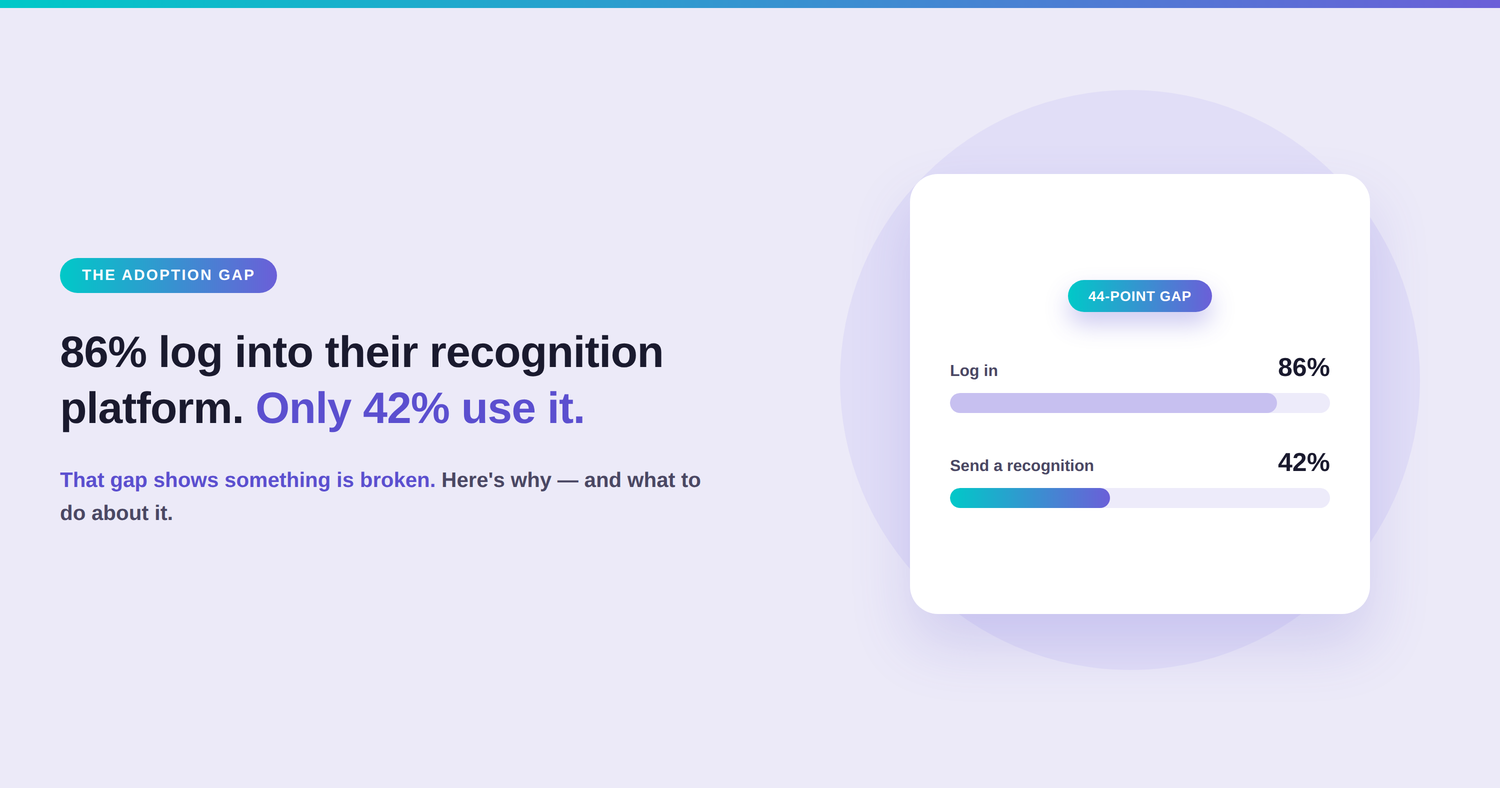
86% of employees log into their company's recognition platform. Only 42% ever send a single recognition.
That gap, 44 points between access and action, is one of the clearest signs that something is going wrong with how most recognition programmes are built. Organisations are investing in the technology, launching it with energy, and then watching adoption quietly stall. People log in, look around, and leave without doing anything.
This is the recognition crisis of 2026. It's not that companies aren't trying. It's that the way most programmes are designed almost guarantees they won't stick.
Why recognition programmes fail
The failure mode is almost always the same, and it begins before a single employee logs in.
Most recognition programmes are launched as initiatives. There's a start date, a comms plan, an all-hands announcement. Maybe a demo, maybe a lunch-and-learn. And then normal life resumes and the platform sits there waiting for people to remember it exists.
Recognition doesn't work as an initiative. It works as a habit. And habits don't form from a launch event, no matter how well executed.
The second failure mode is over-reliance on managers. Many organisations roll out recognition tools and wait for managers to drive adoption. The problem is that manager behaviour is wildly inconsistent. Some managers are naturally expressive with appreciation. Others find it uncomfortable, or simply deprioritise it under operational pressure. When a programme depends entirely on managers to carry it, it's only as strong as the least engaged manager in the building.
The third failure mode is vagueness. "Great job on that project" lands very differently from "the way you restructured that brief, cutting it from 20 pages to six without losing anything important, that's the kind of clear thinking that makes everyone's job easier." Recognition without specificity feels performative. People stop giving it because it feels hollow, and stop expecting it because it rarely means anything.
The data behind the gap
When people log in to a recognition platform and don't act, it usually means one of three things. They don't know what to say. They don't feel it's their place to say it, which is especially common in hierarchical cultures. Or they tried once, it felt awkward, and they haven't been back.
All three of these are solvable. But solving them requires a different approach to how recognition programmes are designed and embedded.
Research from the 2026 State of Employee Recognition shows that in high-performing organisations, those generating 6.1 times more recognition than their peers, three factors consistently separate them from the rest. Manager participation is active and visible. Peer recognition is explicitly encouraged and normalised. And recognition is tied to specific company values, not just general performance.
None of that happens by accident. It's structural.
What a failing programme looks like from the inside
In the first month, a handful of enthusiastic early adopters send recognitions. The platform shows some activity. Leaders feel good about the launch.
By month three, the same five people are still the only ones using it. The recognitions are starting to feel repetitive. Some employees have never received a single one and are beginning to wonder if they're invisible.
By month six, the platform is generating reports that nobody reads because the data is too sparse to be meaningful. Someone in the HR team quietly raises the question of whether the investment was worth it.
By month twelve, it's been relegated to a line in the annual engagement survey. Most employees tick yes when asked if the company has a recognition programme. Very few could tell you the last time they used it.
This trajectory isn't inevitable. But avoiding it requires understanding what's actually needed, not just what's available.
The three things that make programmes work
Organisations with genuinely thriving recognition cultures have typically got three things right.
Leadership visibility matters more than most people think. In high-performing organisations, 82% of managers actively send recognition, compared to just 58% in average companies. The effect cascades downward. When people see their leaders participating genuinely, it signals that recognition is a real cultural value, not a checkbox exercise. Employees are twice as likely to use recognition platforms when they see others consistently doing the same. Leadership behaviour is the single fastest way to shift adoption.
Friction is the enemy of consistency. Complex platforms with clunky workflows don't get used regularly. Recognition needs to happen in the flow of work, not as a separate task that requires logging into a different system, finding the right person, selecting a category, and composing a message from scratch. Every additional step costs participation.
Feedback loops make programmes improvable. Organisations that treat recognition data as a signal about culture, not just a measure of platform engagement, can actually see where the gaps are: teams that are under-recognised, managers who aren't participating, departments where peer recognition is almost non-existent. Without that data, you're flying blind.
How to diagnose your own programme
If you're unsure whether your recognition programme is thriving or quietly failing, a few questions are worth honest answers.
What's your active participation rate? Not login rate, recognition-sent rate. If it's below 50%, you have an adoption problem, not an awareness problem.
Who's sending recognition? If a small group of employees accounts for the majority of activity, the programme hasn't achieved cultural penetration.
Who's receiving it? Are recognitions distributed across departments, levels, and roles, or are they clustering around high-visibility teams and individuals? Uneven distribution is a warning sign regardless of intent.
How specific are the recognitions being given? Generic recognition has a fraction of the impact of specific recognition. If your platform data shows mostly one or two sentence messages with no detail, that's worth addressing.
Turning the crisis into an opportunity
The gap between access and action isn't just a problem. It's an opportunity.
The organisations that close it, that turn their platforms from something people log into occasionally into something that genuinely shapes how teams operate and how people feel, gain a real competitive advantage. Not because recognition is a nice thing to do, but because the downstream effects on engagement, retention, and performance are measurable and significant.
The gap is closable. Not through a bigger budget or a better platform alone, but through intentional design: making recognition easy, making leadership participation visible, connecting recognition to real values, and building the feedback loops that show you what's working and what isn't.
The crisis is real. But it's a crisis of implementation, not of intent.
Qolabi is built to close the adoption gap, with simple peer-to-peer recognition, manager tools, and AI pulse surveys that show you where your recognition culture actually stands. [Learn more →]

